

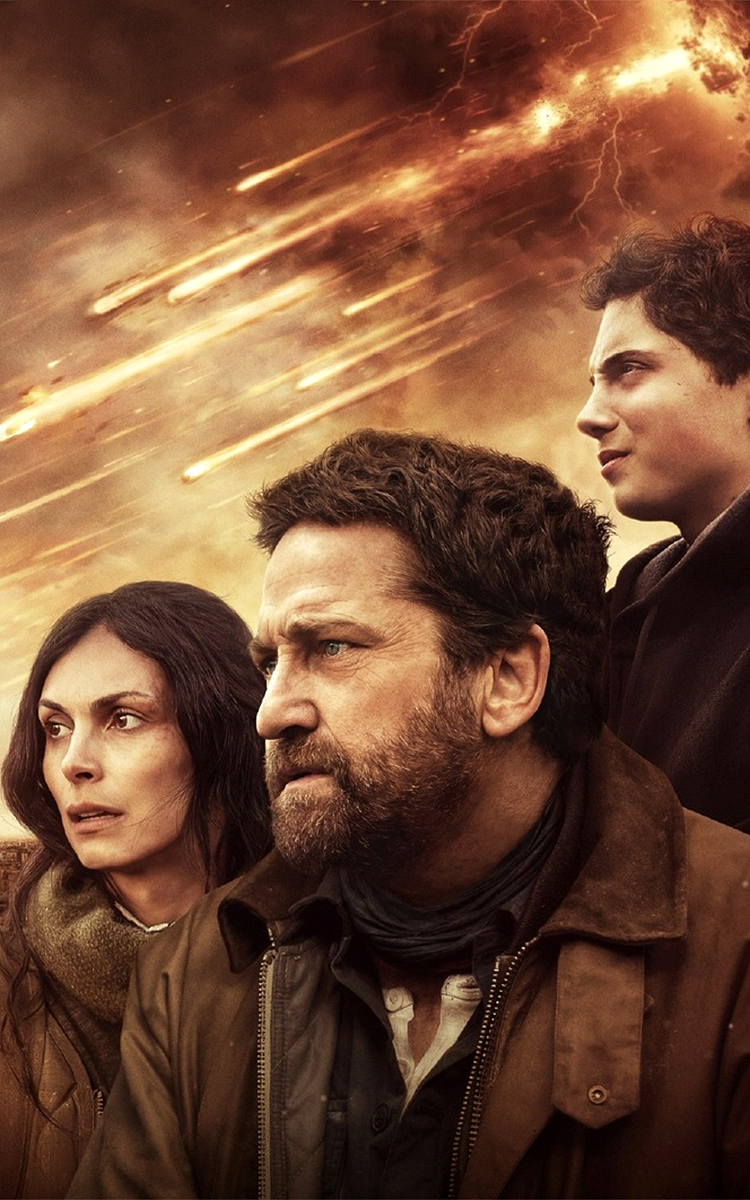
Greenland: Migration (Greenland 2) (2026)
Running Time: 1 hr. 38 min.
MPAA Rating: PG-13
A
s they were crafting and shaping the screenplay, could the writers and filmmakers (including Ric Roman Waugh, who directed the first film) possibly have guessed at the significance of the island of Greenland during the second Trump presidency? Geographically, it plays such a minimal role in the context of the picture itself, yet it couldn’t be more topical in the news as this movie releases theatrically on January 9th, 2026 in the United States. It just might be one of the most fortuitously-named projects ever, opening at the exact moment that the subject of its title has a coincidental boost in interest and relevance.
Nevertheless, the story proper takes place about five years after the events of “Greenland,” at which point 75% or more of the world has been obliterated by the impact of a comet called Clarke. Flaming fragments continue to pelt the surface of Earth, tremors threaten to bring down any still-standing structures, and radiation makes the air unbreathable. John Garrity (Gerard Butler), his wife Allison (Morena Baccarin), and their son Nathan (Roman Griffin Davis) live among hundreds of other survivors in a subterraneous bunker at Thule Airbase in Greenland, to where they previously retreated as Clarke began its devastating atmospheric assault. “Another fissure’s opening up!”
Now that the origins of the catastrophic event have been checked off, this second chapter can begin at a more interesting starting point: what happens to the remnants of humanity, and how do they subsist? “Mad Max: Fury Road”-type storms cause enough damage that the main trio eventually venture out (or flee) from their habitable station in search of a crater zone, rumored to be a safe haven, somewhere near southern France (not unlike the mythical quest for a paradisiacal land seen in “Waterworld”). Along the way, as the previous film dabbled in, audiences are treated to all of the standard zombie movie routines – sans zombies, of course – that occur when societal norms break down. Distress calls, migrants, reports of fighting, actual warfare, therapy and other coping tactics, contamination, insurgents, and all manner of desperate people resorting to desperate actions populate this sequel. Subplots peek at a childhood crush for 15-year-old Nathan, relatives maintaining forgotten facilities, and militarized bases keeping out throngs of angry, suffering civilians. And oddest of all is the introduction of several new characters, every one of which is completely ignored mere minutes after receiving screentime and dialogue. It’s a bit like “Threads,” in that the premise is more important than the individuals – at least for all the personas who are not the three main stars (an unintentional similarity, no doubt). And Nathan’s life-or-death need for insulin receives a lone line of acknowledgement before disappearing forever.
Once again, “Greenland: Migration” gets a few things right, including the panic and chaos that come from the disintegration of law and order (despondency fuels anarchy), as well as the unnerving quality of traveling to new locales with undefined or unknown rules and inhabitants and governance. And John’s survival, largely based on his ability to repair anything with which he crosses paths, and to stay cool in the face of firearms, has a touch of credibility. Unfortunately, very little of what transpires here is original; countless other films have already covered this territory, often with much greater suspense and shock value. “The world is a dangerous place now.”
While a handful of visuals are amusing, alongside nerve-wracking treks and encounters, the PG-13 rating forces many incidents to be improbably tractable; perhaps the most unique aspect of this production is its unlikely, optimistic perspective. The heroes tend to bump into more allies than adversaries, and more luck than adversity; it’s a former cautionary tale transformed into a blueprint for postapocalyptic success. It’s weirdly refreshing to see characters favorably navigate hellish landscapes, intersecting with general goodness rather than opportunistic evil. This is, however, at the expense of realism (and a conclusion that isn’t so sappy), which is altogether absent.
– Mike Massie
- 6/10
Theatrical Release Date: January 08, 2026


