


King Kong (1933)
Running Time: 1 hr. 40 min.
MPAA Rating: Not Rated
1900s-1930s | Adventure | Horror | K
N
ew Yorker Carl Denham (Robert Armstrong), scared of nothing, plots a grand, crazy voyage – one with gas-bomb cargo and copious amounts of ammunition, far too many crew members, and a skipper (Frank Reicher) and First Mate (Bruce Cabot as Jack Driscoll) who don’t know where the destination is. As Carl tries to hurry away from the harbor to avoid problematic customs and inspections, he encounters yet another pitfall – his agent Charles Weston (Sam Hardy) has been unable to acquire an actress to accompany the group, as Carl’s goal is to shoot a picture in an exotic, secret locale. “The public must have a pretty face to look at.”
At the last minute, Carl scours the streets for an unwitting woman who won’t ask too many questions and who won’t concern herself with the fact that she’ll be the only girl on the long sea voyage, among a burly group of bad-tempered, rough-looking men. Practically kidnapping a starving woman from the streets as she contemplates stealing a piece of fruit, Carl coerces young blonde Ann Darrow (Fay Wray) to join him for their 6:00 AM departure. It’s soon revealed that Denham has commissioned the vessel (the Venture) to maneuver to an unexplored island where the native superstitions of a monstrous deity called “Kong” have stuck with the few sailors ever to cross – and successfully return from – the secluded landmass.
“This is no place for a girl.” It’s reiterated over and over again that Ann is a nuisance and can’t help but to get in the way. Women are simply manufactured that way. The dialogue at the start is incredibly sexist, though it lends to the idea of women being separated from the beasts of humanity; the men here are particularly unfriendly or brutish, while Ann is specifically naive and fragile. This also ties into the “beauty and the beast” theme, with its sexual undertones, which is so pronounced (“play up that angle!”) that the characters actually speak that phrase repeatedly – as if audiences will be too stupid to understand the visual contrasts, or the primal motivations of the monster on Skull Mountain.
The foreshadowing is clumsy and unsubtle; the music is overwrought and loud; and the acting and scripting are clunky and campy. Most of the events leading up to Kong’s appearance are downright laughable in their shoddiness and unconvincing interactions, while insincerities abound and thrills are routinely numbed by poor delivery or comical word choices for conversations. Plus, in classic B-movie fashion, concepts like romance move unexpectedly fast. “I guess I love you,” whimpers Jack. To which Ann gasps, “Why, Jack! You hate women!”
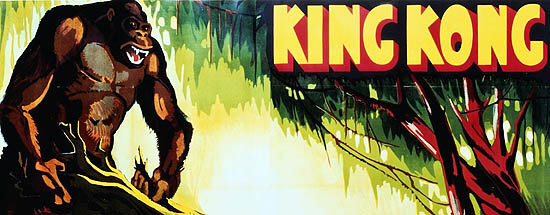
Despite its many storytelling flaws, the real attraction here is the “Eighth Wonder of the World,” Kong himself. If the first half of the film is inadequately designed, brimming with dismal acting, and made ridiculous by pitiful plot contrivances, the second half is pure spectacle, showcasing a massive tribal ceremony on an enormous set, and battle after battle as the titular creature fails to get a moment of peace to woo his new target (or to properly poke, prod, and partially disrobe her). It takes 45 minutes for the oversized ape to crash through the treetops to spy Wray screaming her lungs out, which certainly sets a precedent for lengthily stalling the big reveal of an antagonist for the sake of unmatched anticipation. Cleverly, the girl then tumbles out of view for a brief second, allowing the impressively dexterous Kong to pluck her up – now in the form of a stop-motion model to match the lumbering, stiff-faced primate puppet.
The special effects are, by today’s standards, quite primitive and elementary; but in 1933, they would have been stunning. Kong’s entrance is additionally supplemented by a dinosaur charge, a rubbery sea monster, a boxing/wrestling T-Rex, and a pesky pterodactyl. Interestingly, Kong all by himself would have been enough to enthrall audiences, yet the filmmakers (led by Merian C. Cooper) opted for more ambitious components. Unfortunately, even accounting for the passage of time, the performers and the writing are deficient. Nevertheless, when Kong rampages through the native village, tracks his blonde bride, and stomps a man into the mud with a tremendous furry foot, the entertainment value is undeniably high. The uncaring cruelty toward the sideshow attraction (perhaps a metaphorical revenge by Mother Nature) culminates in the iconic, chaotic ascent of the Empire State Building and an aerial showdown, after which Denham can famously spout yet again, “It was beauty killed the beast.”
– Mike Massie
- 7/10

Theatrical Release Date: April 07, 1933


